

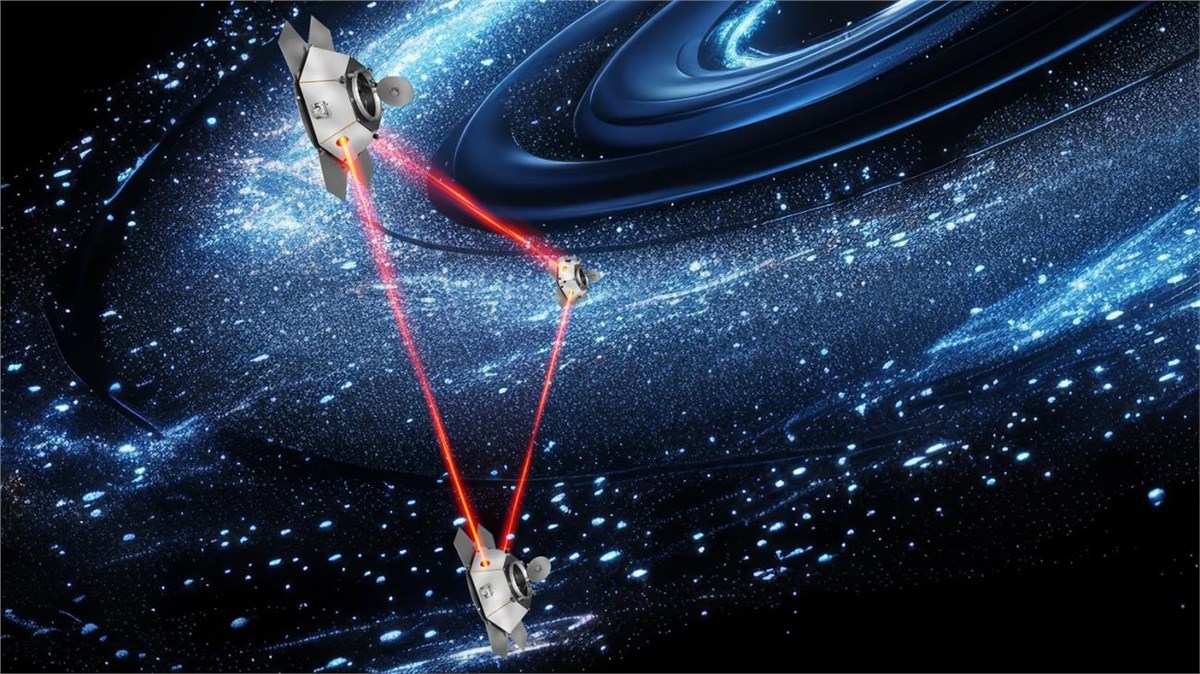
Thales Alenia Space, the joint venture between Thales (67 percent) and Leonardo (33 percent), has announced the signing of a €26.1 million Phase 1 contract with the European Space Agency (ESA) related to the development of LISA’s telescopes. Made up of three satellites, the LISA (Laser Interferometer Space Antenna) mission will be the first European space observatory capable of detecting and studying gravitational waves generated by extreme cosmic events.
This announcement follows the signing of two other contracts related to the same mission. In June 2025, Thales Alenia Space announced a contract with prime contractor OHB System AG to provide several critical elements, including spacecraft avionics and control software, the telecommunication system, and the drag-free and attitude control system (DFACS). In January 2026, the company was also selected by OHB System AG to provide the propulsion subsystem.
Thales Alenia Space’s Optical Excellence at the Service of Space Exploration
In France, Thales Alenia Space and Thales SESO, which are responsible for developing the optical payload telescopes, will make a major contribution to the mission. Based on its globally renowned expertise in the design and manufacture of advanced optical technologies, Thales Alenia Space has been selected by ESA to conduct Phase 1 for the development of the six telescopes, which is expected to proceed in three phases.
As prime contractor, Thales Alenia Space will be responsible for the development, design, assembly, and testing of the telescopes. The manufacture of the six telescopes, made entirely of Zerodur, will present an unprecedented technological challenge. It is the combined expertise in design and manufacturing of Thales SESO and Thales Alenia Space, along with Zerodur’s extremely low thermal sensitivity, that will enable the picometer-level stability required by the LISA mission.
Filippo Marliani, LISA Project Manager at ESA, stated:
“LISA represents a pioneering initiative in astrophysics and space exploration that has not previously been attempted. Thales Alenia Space is responsible for several mission-critical components of the LISA project. I am pleased to expand our collaboration with Thales Alenia Space to include the first phase of the development of the telescopes, significantly mitigating the risk of this technological challenge. I am looking forward to seeing the first results of this development by year-end.”
Bertrand Denis, Vice President of Observation, Science, and Exploration at Thales Alenia Space in France, added:
“We are extremely proud to be part of this exceptional mission dedicated to the study of gravitational waves from space, and we would like to thank ESA for its renewed trust. The development of these telescopes is fully aligned with the core expertise of Thales Alenia Space and Thales SESO in high-performance optical instrumentation. Our capability to produce instruments in series will also be a real asset to the project’s success.”
LISA: The First Space-Based Observatory for the Study of Gravitational Waves
LISA is a unique space exploration mission by ESA designed to detect gravitational waves directly from space. The mission consists of a constellation of three satellites, each spaced 2.5 million kilometers apart, forming an equilateral triangle. The three satellites are scheduled to launch in 2035 aboard an Ariane 6 rocket.
