

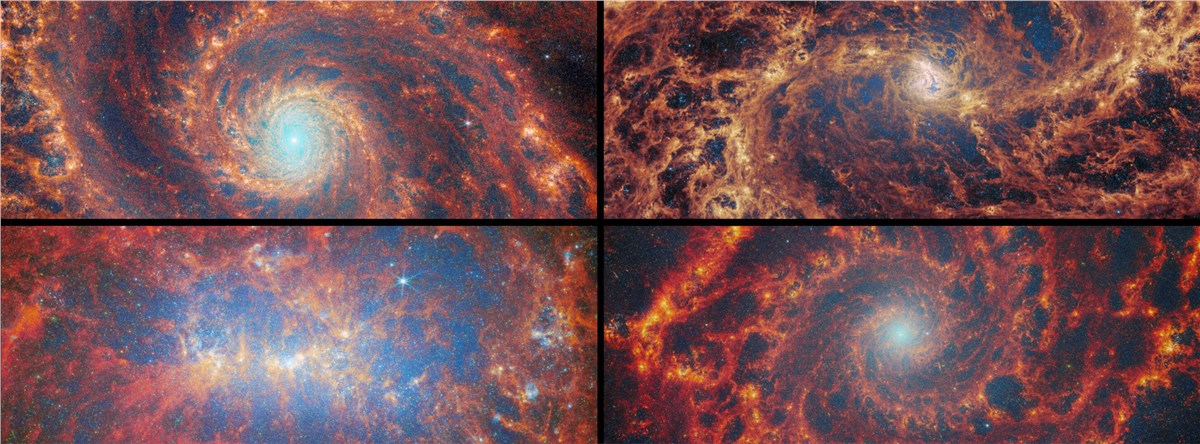
Astronomers using the NASA/ESA/CSA James Webb Space Telescope together with the NASA/ESA Hubble Space Telescope have looked deeply at thousands of young star clusters in four nearby galaxies, studying clusters at different stages of evolution. Their findings show that more massive star clusters emerge more quickly from the clouds in which they are born, clearing away gas and filling the galaxy with ultraviolet light. The result provides a better understanding of star formation in galaxies, as well as how and where planets can form.
Astronomers have long known that understanding how star clusters form is key to unlocking other secrets of galactic evolution. Stars form in clusters when clouds of gas collapse under gravity. As more stars are born, strong stellar winds, harsh ultraviolet radiation, and supernova explosions eventually disperse the cloud, ending star formation before all gas is used up. This process, called stellar feedback, means that most of the gas in a galaxy never gets used for star formation.
Studies of the closest star-forming regions in the Milky Way allow astronomers to examine star clusters in fine detail, but our position within the galaxy limits visibility. By observing nearby galaxies with space telescopes such as Hubble and Webb, astronomers can survey thousands of star-forming regions and characterize entire populations of star clusters at many stages of evolution.
An international team of astronomers analyzed images of four nearby galaxies — Messier 51, Messier 83, NGC 4449, and NGC 628 — from the FEAST observing programme. The team identified nearly 9,000 star clusters in different evolutionary stages: young clusters just beginning to emerge from their natal gas clouds, clusters that had partially dispersed the gas (observed with Webb), and fully unobstructed clusters visible in optical light (observed with Hubble). Using Webb’s ability to peer inside gas clouds, they estimated the mass and age of each cluster from its light spectrum. The most massive clusters fully emerged and dispersed their gas clouds after approximately five million years, while less massive clusters took seven to eight million years to emerge.
Angela Adamo of Stockholm University and the Oskar Klein Centre in Sweden, lead author and Principal Investigator of the FEAST programme, stated:
“Simulations of star formation and stellar feedback have struggled to reproduce how star clusters form and emerge from their natal clouds. These results give us important new constraints on that process.”
Massive star clusters naturally emit most of the ultraviolet light in galaxies, but this work confirms they also gain a head start on producing stellar feedback over lighter clusters. Knowing where and when stellar feedback is strongest throughout a galaxy’s lifetime allows astronomers to better predict how star-forming fuel moves through the galaxy.
Alex Pedrini, lead author also of Stockholm University and the Oskar Klein Centre, added:
“This work brings together researchers simulating star formation and those working with observations, as well as groups researching planet formation. Using Webb, we can look into the cradles of star clusters and connect planet formation to the cycle of star formation and stellar feedback.”
