

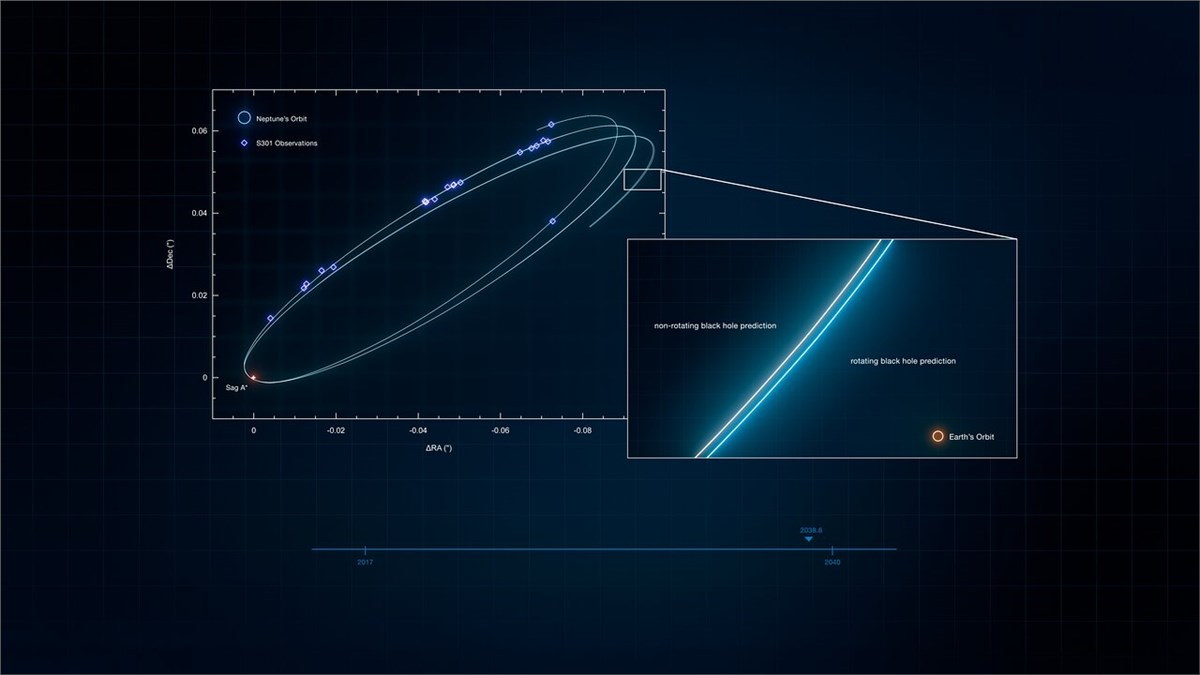
Astronomers have discovered the fastest known star in the Milky Way, orbiting the supermassive black hole at the centre of our galaxy. Named S301, the star was detected using the European Southern Observatory’s Very Large Telescope Interferometer (ESO’s VLTI) and reaches speeds of approximately 25,000 kilometres per second as it travels around the four-million-Solar-mass black hole Sagittarius A*.
S301 follows an exceptionally close orbit around Sagittarius A*, bringing it closer to the black hole than any other observed star. Its proximity means the star is affected by the rotation of the black hole, potentially providing a new way to study the properties of spacetime in an extreme gravitational environment.
“Decades carefully tracking stars orbiting our galaxy’s central black hole, Sagittarius A*, have led to this breakthrough discovery of a very promising star,” said Nobel Prize winner Reinhard Genzel, Director at the Max Planck Institute for Extraterrestrial Physics (MPE) in Garching, Germany. “Because it orbits so close to Sagittarius A*, S301 opens a new window to the fundamental properties of spacetime in this extreme black-hole environment.”
S301 completes an orbit around Sagittarius A* in just 8.7 years. At its closest approach, it comes within approximately 12 times the distance between Earth and the Sun.
“What is special about this star is that it’s orbiting Sagittarius A* on a very tight orbit, taking just 8.7 years to complete it, and is approaching the black hole at a mere 12 times the distance of Earth to the Sun. That is unprecedented,” said Felix Mang, a PhD student at MPE and author of the study published in Nature.
During its closest passage, S301 reaches approximately 25,000 kilometres per second, making it around 100,000 times faster than a commercial aircraft and more than 8% of the speed of light. This makes S301 the fastest known star in the Milky Way.
S301 also approaches Sagittarius A* at approximately the distance of Saturn from the Sun. Its exceptionally close orbit could allow astronomers to use the star to measure the rotation of the central black hole.
Astronomers expect Sagittarius A* to rotate. According to Einstein’s general theory of relativity, a rotating black hole drags and twists spacetime around it, influencing the orbits of nearby objects. This effect becomes stronger for objects orbiting rapidly rotating black holes at close distances.
“With this star we hope to measure, within the next 10 years, the spin of the black hole,” said Mang. MPE researcher Stefan Gillessen added, “For the first time, we would actually be able to measure very directly the spin of a massive black hole, which would be a key test of Einstein’s theory.”
Juan Osorno, an astronomer at LIRA Observatoire de Paris–PSL in France and a contributor to the study, said that without S301, measuring the black hole’s spin through stellar motion could require several more decades of observations.
Detecting S301 was challenging because the star appears approximately two billion times fainter than Betelgeuse, the orange star in the constellation Orion. The research team used the VLTI at ESO’s Paranal Observatory in Chile together with its GRAVITY instrument, now known as GRAVITY+ following an infrastructure upgrade.
The VLTI combines light from four 8-metre telescopes to create a virtual telescope with 15 times the spatial resolution of a single 8-metre telescope.
“Worldwide, Paranal is the only place where you can do this type of observations because no other observatory in the world has four 8-metre telescopes that can act together as an interferometer,” said Frank Eisenhauer, GRAVITY+ Principal Investigator and Director at MPE.
Using GRAVITY and later GRAVITY+, researchers first detected S301 in spring 2023 and have continued observing it to constrain its orbit. They also traced its orbital history back to 2017 and determined that its most recent closest approach to Sagittarius A* occurred in early 2023.
The star’s orbital properties, combined with the fact that stars cannot form so close to a massive black hole, suggest that S301 may have originally been part of a binary star system. Researchers propose that the binary was disrupted by the tidal forces of Sagittarius A*, leaving S301 trapped by the black hole’s gravity while its companion was ejected at high velocity, potentially fast enough to leave the galaxy.
Further observations with GRAVITY+ and the MICADO instrument on ESO’s upcoming Extremely Large Telescope (ELT) will be used to track S301 over the next decade. The star is expected to make its next closest passage to Sagittarius A* in 2031.
Observing at least two complete orbits of S301 could allow researchers to constrain its trajectory with sufficient precision to directly determine the spin of Sagittarius A* for the first time.
“That would be a dream come true,” said Mang.
