

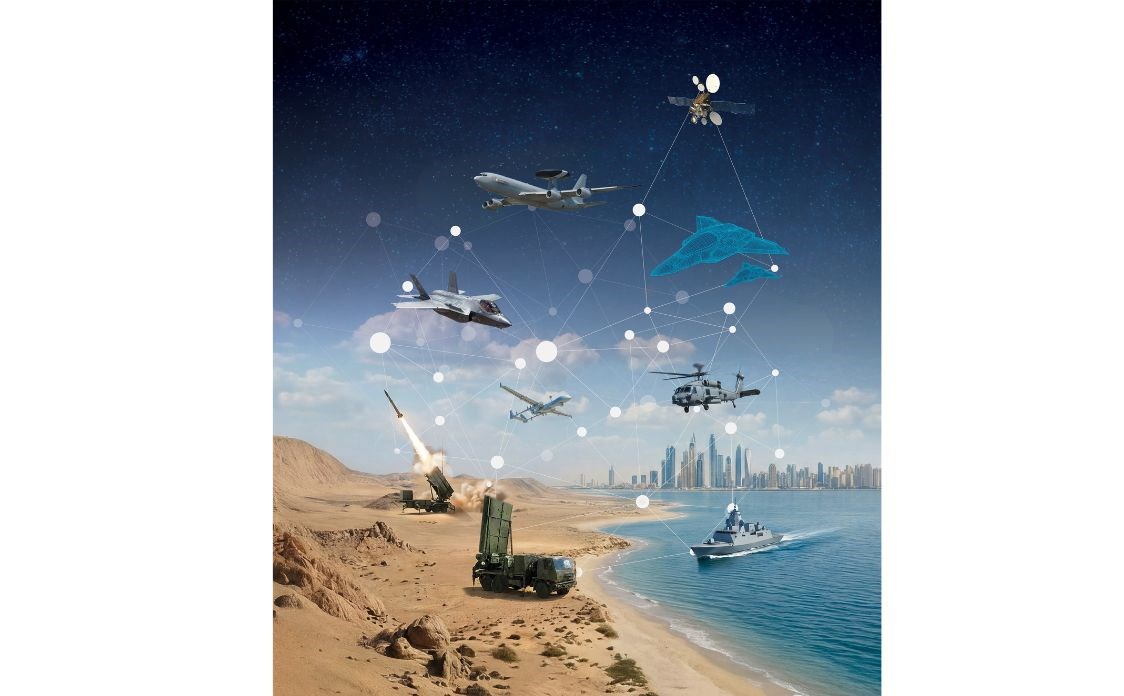
Israel Aerospace Industries (IAI) is unveiling OPAL Next Generation (NG), the latest evolution of the company’s airborne decentralized battle management solution for sixth-generation platforms. Building on over a decade of continuous development and ongoing operational experience, OPAL-NG is based on the legacy OPAL that supports interoperability with NATO standards, including Link-16, and is already deployed across a wide range of platforms, including fighter aircraft, helicopters, UAVs, mission and AEW aircraft, naval vessels, and command centres.
OPAL-NG introduces new key advancements including the integration of edge-based artificial intelligence, enhancing real-time data processing, prioritization, and decision support at the platform level for enhanced manned-unmanned teaming (MUM-T) and Collaborative Combat Aircraft (CCA) capabilities. Enabling unmanned platforms to operate as an extension of manned assets, OPAL-NG allows dynamic sharing of sensing, electronic warfare, interception, and strike functions through continuous real-time collaboration during mission execution. The extended evolution of the legacy OPAL includes real-time decentralized networking, supporting faster and more resilient multi-domain operations in complex and challenging environments.
Boaz Levy, IAI’s Chairman of the Board, stated:
“Future combat will be defined by interoperability, speed, and the ability to operate as a cohesive, multi-domain force. OPAL-NG reflects our long-term investment in advanced battle management solutions that connect platforms, systems, and operators into a single operational framework. By introducing AI-enabled processing and enhanced collaboration between manned and unmanned systems, we are enabling faster, more informed decision-making in increasingly complex operational environments.”
Yaacov Berkovitz, EVP & GM of IAI Aviation, added:
“OPAL-NG fundamentally changes how forces operate by creating a shared operational picture across platforms and domains. The added capabilities further strengthen real-time operations, enabling faster sensor-to-shooter cycles and more effective coordination between distributed assets. With its open architecture and flexibility, OPAL-NG allows forces to integrate existing systems, while further enhancing their operational capabilities on existing and new platforms.”
At its core, OPAL-NG creates a shared operational picture between platforms, allowing them to exchange, in addition to data, high-quality voice, imagery, video, and mission-level insights in real-time. This capability enables all participating platforms to operate based on a common operational picture, significantly improving coordination, effectiveness, and survivability. The system shortens the sensor-to-shooter cycle by transforming large volumes of multi-source data into actionable insights within milliseconds, supporting time-critical targeting and dynamic mission execution.
Designed as a standards-based, open architecture framework, OPAL-NG allows customers to integrate existing systems, datalinks, and software-defined radios, while also enabling the independent development of operational applications tailored to indigenous and evolving mission needs.
