

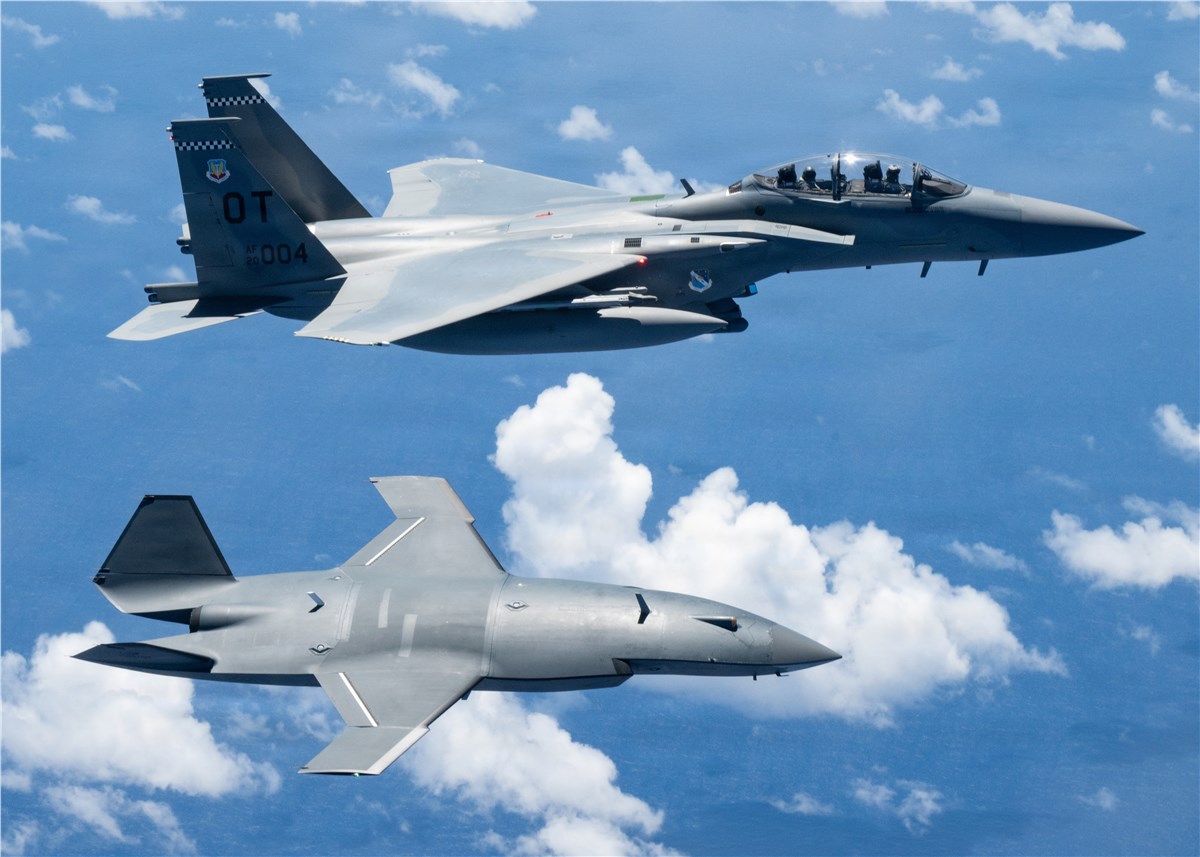
Air forces around the world are moving toward the practical introduction of Collaborative Combat Aircraft (CCA), also referred to as strike-fighter drones for air-to-ground operations. Germany is also developing plans to establish this emerging capability.
Boeing and Rheinmetall are proposing the MQ-28 Ghost Bat as a platform that could support Germany in building CCA capabilities. Previous flight testing has demonstrated the MQ-28’s ability to support both air-to-ground and air-to-air operations.
The maturity of the MQ-28 would allow Germany to develop sovereign capabilities while integrating German sensors, weapons and mission software. Boeing is continuing to develop the MQ-28, including its air-to-ground capabilities, while Rheinmetall is contributing as the system integrator to support the development of CCA capabilities in Germany.
The MQ-28 Ghost Bat has already participated in multinational exercises, including the U.S. military’s Valiant Shield exercise. Glen Ferguson, Boeing Defense Australia Global Director of the MQ-28 programme, said the aircraft has already progressed through development stages that many other CCA programmes are still working through.
The MQ-28 could also provide the German Air Force with a development and test environment for establishing procedures and tactics for cooperation between manned and unmanned aircraft. Ferguson said that if Germany aims to establish such a capability by 2029, work on tactics, training, force structure and integration of sovereign technologies would need to begin now.
Boeing is working with Rheinmetall, Rohde & Schwarz, Diehl Defence and HENSOLDT to develop an industrial ecosystem intended to support Germany’s ability to develop and integrate CCA-related capabilities domestically.
Rheinmetall is taking an initial step by establishing an independent system integration capability for the MQ-28 in Germany. Mike Schmidt, CEO of Rheinmetall’s Business Unit Air, Uncrewed and Space, said Germany could pursue both speed and independence by using the MQ-28 as an established platform rather than beginning with the development of an entirely new aircraft.
The establishment of independent system integration is also intended to strengthen Germany’s defence industry. Software development, mission integration and intellectual property would remain within the German industrial ecosystem, allowing national capabilities to be developed, tested and integrated on the MQ-28.
The experience gained through the MQ-28 programme could also support the development of future CCA platforms. Boeing is continuing to develop the aircraft using a digital twin, extensive flight-test data and information from its test programme with the Royal Australian Air Force (RAAF).
According to Ferguson, the MQ-28 was designed as an adaptable platform, with its architecture allowing changes to accommodate new mission requirements. He said the addition of air-to-ground capabilities is based on the aircraft’s modular design rather than a retrofit approach, allowing the platform to be continuously adapted.
