

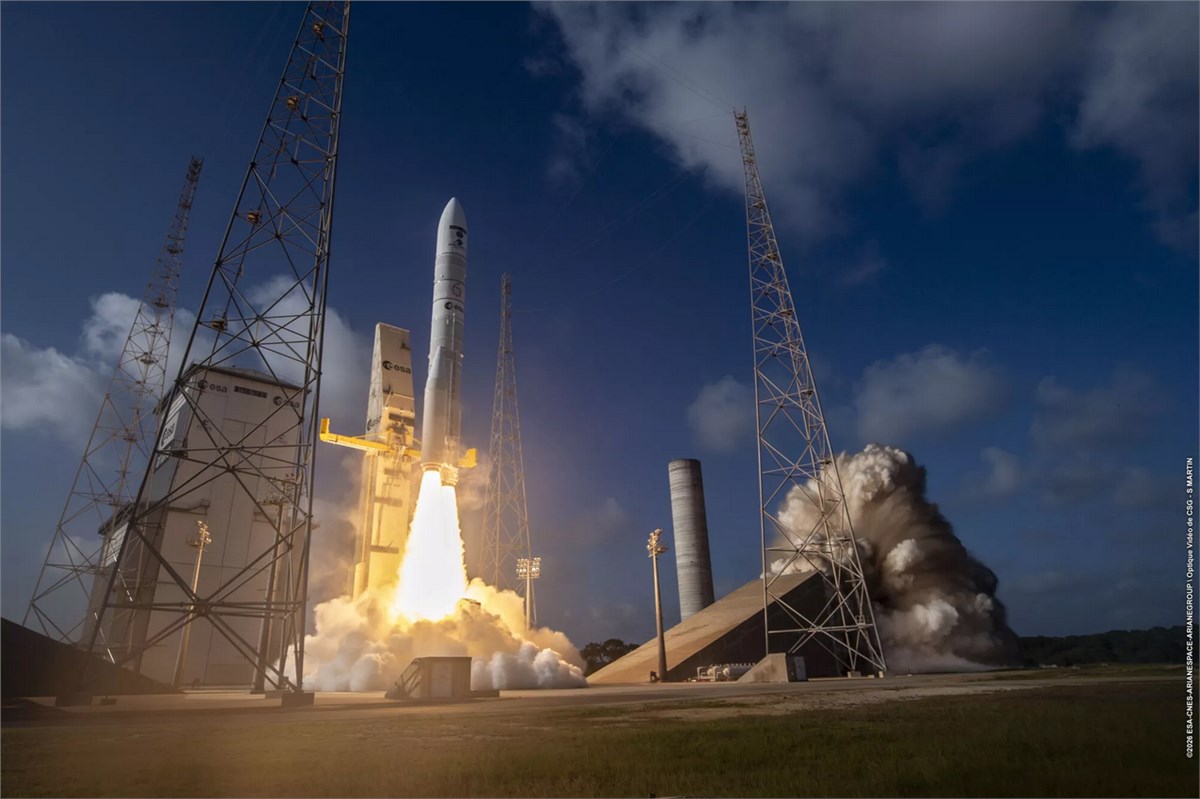
Arianespace has successfully launched MTG-I2, the second Meteosat Third Generation Imager satellite, aboard an Ariane 62 launcher from Europe’s Spaceport in French Guiana. The mission marked Ariane 6’s first launch to geostationary transfer orbit (GTO).
The Ariane 62, the two-booster configuration of Ariane 6, accurately injected MTG-I2 into GTO at an altitude of 2,778 kilometres above the Equator. Thirty-six minutes after liftoff, the satellite successfully separated from the launcher and continued its journey towards its operational geostationary orbit (GEO) at an altitude of 36,000 kilometres.
“The success of the MTG-I2 mission, Ariane 6’s first launch to geostationary transfer orbit, marks a major milestone for the programme,” said David Cavaillolès, CEO of Arianespace. “By launching this meteorological satellite, which will provide essential data for European citizens, Arianespace has once again demonstrated its ability to meet the needs of major institutional missions, while confirming the availability of a reliable, sovereign launch service aligned with Europe’s ambitions. We would like to thank the teams of our customer EUMETSAT for their continued trust.”
Christophe Bruneau, CEO of ArianeGroup, said the mission demonstrated Ariane 6’s versatility and precision during its first flight to geostationary transfer orbit.
“With its first mission to geostationary transfer orbit, Ariane 6 has once again demonstrated its versatility and precision,” Bruneau said. “This latest success confirms the launcher’s ability to meet the requirements of Europe’s most strategic space programmes. Following the introduction of the four-booster version, and the enhanced P160C boosters earlier this year, it marks another milestone in the ramp-up of Ariane 6 — the fastest ever achieved for a heavy-lift launcher.”
The Meteosat Third Generation programme comprises a new generation of geostationary satellites designed to provide imagery for early detection of rapidly developing severe storms, weather forecasting and climate monitoring. The combination of MTG’s instruments, increased resolution and enhanced sensitivity is intended to improve weather observation compared with the Meteosat Second Generation system.
The MTG system is designed to support early detection and prediction of rapidly evolving and potentially dangerous weather events, including severe thunderstorms. The fleet will comprise two imaging satellites and one sounding satellite operating approximately 36,000 kilometres above Earth.
MTG-I2 completes the first family of the MTG system. The satellite will provide a rapid-scan service over Europe every 2.5 minutes while working alongside Meteosat-12, also known as MTG-I1. MTG-I1 was successfully launched by Ariane 5 VA259 in December 2022, with the two satellites supporting continuity and resilience for Europe’s operational meteorological services.
The MTG satellites were developed by the European Space Agency (ESA) based on user requirements collected by EUMETSAT. They were built by a consortium of European industries led by prime contractor Thales Alenia Space, with OHB System in Germany and Leonardo in Italy among the main partners.
EUMETSAT is responsible for developing the ground infrastructure used to control and communicate with the satellites, operating the spacecraft throughout their lifetimes and distributing scientific data to users worldwide.
Ariane 6 is an ESA programme developed to support the availability of a sovereign and reliable launch system for ESA Member States, with the agency responsible for development and monitoring operations.
