

Exolaunch is set to deploy 68 customer satellites for 40 customers across two upcoming rideshare missions with SpaceX. The company will deploy 45 satellites aboard Transporter-18 and another 23 aboard Bandwagon-5, with both missions scheduled to launch on Falcon 9 rockets no earlier than October 2026.
Transporter-18 is scheduled to launch from Vandenberg Space Force Base in California, while Bandwagon-5 will launch from Cape Canaveral Space Force Station in Florida. Conducting two major launch campaigns simultaneously from opposite U.S. coasts highlights the scale of Exolaunch’s operations and provides customers with access to both sun-synchronous and mid-inclination orbits.
Across the two missions, Exolaunch will support 40 new and existing customers from Argentina, Canada, Denmark, Finland, France, Germany, Italy, Lithuania, Luxembourg, the Netherlands, Norway, Singapore, South Korea, Spain, Sweden, Taiwan, Turkey, the United Kingdom, the United States and other countries.
The missions reflect demand for launch capacity, satellite integration, deployment technologies and operational expertise needed to move spacecraft from production facilities into orbit. Exolaunch provides launch planning and capacity procurement, mission management, environmental testing, satellite integration, international shipping and customs clearance, as well as orbital deployment using its flight-proven technologies.
Drawing on more than a decade of launch experience, Exolaunch will provide these capabilities across both campaigns. The company said its integrated approach is designed to simplify mission operations for satellite operators, whether they are deploying individual spacecraft or larger constellations.
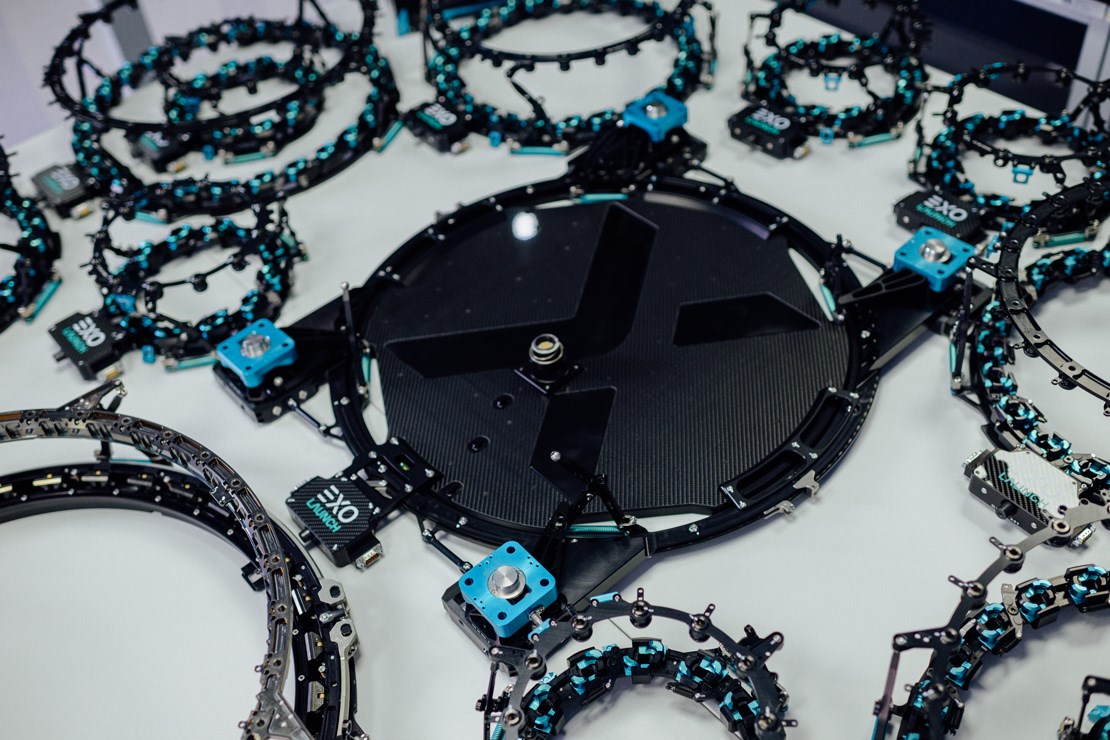
The upcoming missions will use Exolaunch’s portfolio of deployment technologies to support satellite constellations, CubeSats and individual payloads weighing up to 1,000 kilograms. The systems include CarboNIX separation rings in multiple sizes for precise, low-shock microsatellite separation; CarboNIX NEO separation rings designed to withstand higher loads and support satellites weighing up to 1,400 kilograms; Quadro Arrow separation systems for synchronised four-point deployment; and EXOpod Nova deployers for standard and high-volume, high-mass CubeSats.
Exolaunch will also introduce its Quadro Versa microsatellite separation system during the Transporter-18 mission. Designed for satellites weighing up to 1,000 kilograms using four-point interfaces, Quadro Versa combines high strength and stiffness with low tip-off rates. Its performance is enabled by Exolaunch’s synchronised-pusher mechanism, which is designed to provide controlled and predictable spacecraft separation.
“Introducing Quadro Versa marks an important milestone in our mission to provide world-class separation systems for virtually any satellite design,” said Connor Pollock, Vice President of Launch and Engineering at Exolaunch. “It combines the strength and flexibility required by the next generation of spacecraft with the precise deployment performance our customers expect. Its development reflects the dedication of our team, the trust of our customers.”
Exolaunch has deployed satellites on every SpaceX rideshare mission since the programme began. Over the past six years, the company has expanded its operations alongside SpaceX’s rideshare programme, growing its customer portfolio, adapting to technical requirements and supporting hundreds of satellites on their journeys to orbit.
“SpaceX has transformed access to orbit by building a rideshare program capable of launching at extraordinary scale,” said Michael Tolstoj, Vice President of Launch and Engineering at Exolaunch. “Exolaunch has grown alongside that program, developing the technical solutions and operational infrastructure required to turn launch capacity into reliable access to space. Managing 68 satellites across two simultaneous campaigns, at different launch sites and for different target orbits, demonstrates the scale at which our teams now operate.”
Exolaunch recently announced agreements for two Falcon 9 missions, Exo-1 and Exo-2, scheduled for 2027 and 2028 respectively. Using Exolaunch’s flexible EXOtube multi-satellite launch adapters, the missions are intended to provide additional launch opportunities for customers.
With the ongoing acquisition by EQT Private Equity, Exolaunch continues to expand its position as a launch integrator for small satellite operators, offering launch opportunities supported by its flight heritage and operational experience.
The company said additional missions will be announced as it continues to expand its global launch programme.
