

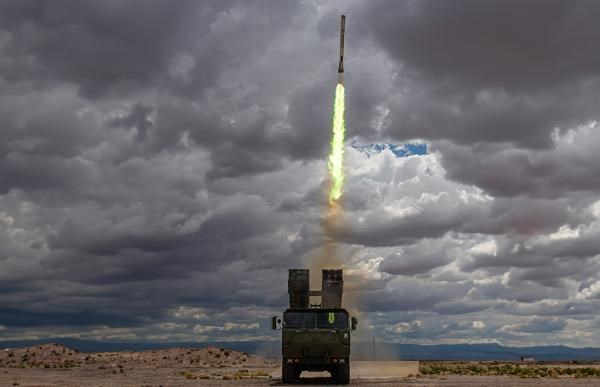
Lockheed Martin has successfully completed the second test of its new Joint Reduced Range Rocket (JR3), an affordable training round with a reusable launch pod designed to replace the current Reduced Range Practice Rocket for the U.S. Army and global partners.
During the flight test at Yuma Proving Ground in Arizona, Lockheed Martin launched multiple JR3 training rounds from a HIMARS, demonstrating the system’s range, trajectory, accuracy and marking payload effects.
The JR3 system is designed for use with HIMARS and M270 launchers. Its all-up round and 24-rocket launch pod are intended to support launcher crew training under different environmental conditions while enabling higher-volume live-fire exercises.
The solution uses mature rocket motor technology and features a low-cost motor and adaptable payload. Its reusable launch pod and reloadable launch tubes are designed to support repeatable training cycles while reducing the expense per round.
The system is intended to allow launcher crews to conduct realistic live-fire drills on constrained ranges, during both day and night, and across multiple locations. The higher training volume is designed to support greater readiness while maintaining a lower cost per training round.
“Our new training round offers a scalable, very affordable solution built on mature rocket motor technology,” said Dave Griser, vice president, Lockheed Martin Precision Fires Rockets. “With a 24-round rocket launch pod, our JR3 system meets the Army’s demand for higher training volume and lower cost without sacrificing performance.”
Lockheed Martin plans to conduct another JR3 flight test later this year to further validate the system’s performance.
The JR3 architecture and technology are also designed to be transferable to future evolutionary programmes, including the Army’s Direct Support Fires Technology initiative for mass-produced, low-cost direct-fire rockets.
