

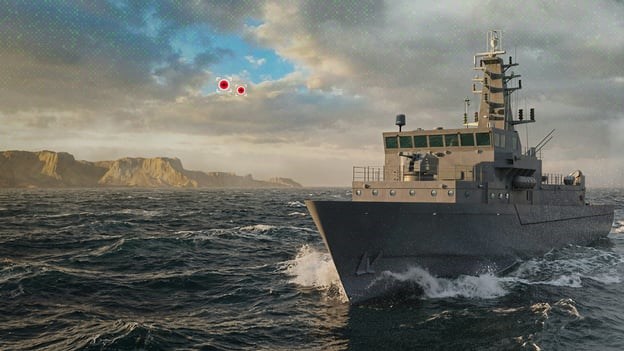
Robin Radar Systems has introduced IRIS OTM at Sea, a major expansion of its IRIS On-The-Move (OTM) capability that brings rapid-response drone detection to ports, vessels, harbours, and critical maritime infrastructure. Designed for seamless land-to-sea deployments, the comprehensive update will strengthen counter-UAS protection for shipping lanes, naval operations, and coastal assets.
Countering Maritime Threats
The announcement comes at a time of heightened instability across global shipping routes, with recent tensions in the Gulf and the Strait of Hormuz underscoring the growing threat posed by drones to international trade, ports, offshore assets, and civilian vessels.
As fixed-wing Shahed drones and low-flying unmanned systems become increasingly prevalent across maritime environments, governments and operators are seeking scalable, rapidly deployable sensing systems capable of delivering reliable early warning at sea.
Siete Hamminga, CEO of Robin Radar Systems, stated:
“What we are seeing globally is that the drone threat is no longer confined to the battlefield or to land-based infrastructure. Shipping lanes, ports, harbours, and offshore assets are now all exposed to low-cost aerial threats that can disrupt trade, damage infrastructure, and threaten civilian safety. The Strait of Hormuz has once again demonstrated how vulnerable critical maritime corridors can become during periods of instability. IRIS OTM at Sea is being designed to answer that challenge with a rapidly deployable, software-defined capability that can move seamlessly between land and sea.”
Originally developed to operate from moving land vehicles travelling at speeds exceeding 100 kilometres per hour, IRIS On-The-Move will now be adapted for maritime environments through advanced software enhancements that compensate for sea clutter, vessel movement, and challenging coastal conditions.
Extreme Marine Environments
Designed to be mounted on vessels, IRIS OTM at Sea will detect, track, and classify drones while travelling at speeds of up to 54 knots, operating effectively in extreme environments thanks to its salt- and corrosion-resistant engineering, resonance tolerance, and EMC-compliant architecture.
Unlike traditional static radars, IRIS is designed to move with the threat itself, providing persistent situational awareness across highly dynamic environments. The radar’s software architecture will be updated to filter out heavy sea reflections and environmental clutter to isolate small airborne threats operating close to the waterline.
Vivien Croes, Chief Technical Officer of Robin Radar Systems, added:
“Modern security demands speed and flexibility. Operators need systems that can deploy quickly, integrate easily, and adapt as threats evolve. What makes this update important is that we are taking a combat-proven radar and extending its capabilities into one of the most operationally complex environments in the world. The future of counter-UAS is not static infrastructure; it is agile, mobile sensing systems capable of protecting people, critical infrastructure, and global commerce wherever threats emerge.”
